

ResQ’s Positive Impact Was 60× Bigger Than its Footprint in 2024
Article in short:
- First handprint assessment conducted: ResQ Club’s first carbon handprint assessment, conducted by NGS Finland, confirms a strong net-positive climate impact by enabling the rescue of surplus food and goods.
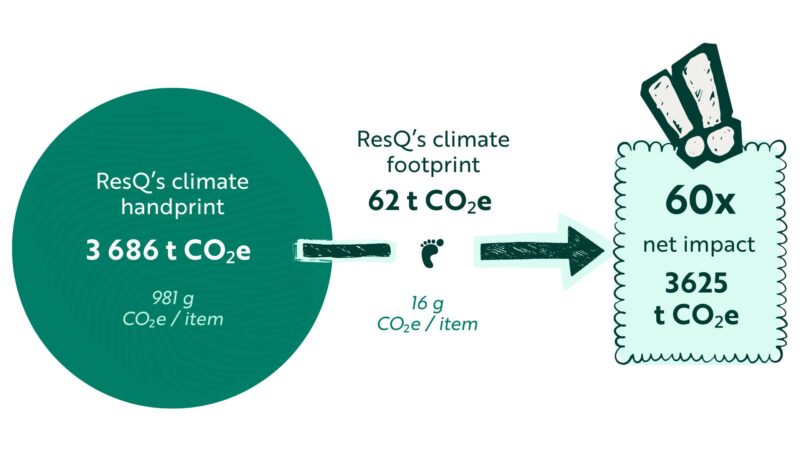
- 60x Climate Benefit: In 2024, ResQ’s total carbon handprint (emissions avoided) was 3 686,4 t CO₂e, nearly 60 times greater than its operational carbon footprint (61,7 t CO₂e).
- Net Positive Climate Impact: The resulting net positive climate impact was 3 624,6 t CO₂e, equivalent to avoiding the emissions from driving over 26 million km in a gasoline vehicle.
- Methodology: The positive impact was calculated using a Life Cycle Assessment (LCA), comparing a baseline scenario (item becomes waste) with the ResQ scenario (item is rescued and consumed).
- Future implications: The report underscores that the greatest climate lever for ResQ is scaling its service to enable more rescues, rather than marginal operational tweaks.
At ResQ Club, we’ve always known that rescuing surplus food matters. But now we finally have the numbers to prove just how much. Our first full carbon handprint assessment, conducted by independent consultancy NGS Finland, confirms that ResQ delivers a strong net-positive climate impact.
In our previous blog post, we unpacked our carbon footprint. This time, we’re diving into the carbon handprint to reveal the full extent of the climate benefits created through ResQ.
What Is a Carbon Handprint and Why Does It Matter?
You’ve probably heard of a carbon footprint: the emissions created by an activity or organization. A carbon handprint captures the opposite — the positive climate impact enabled by a product or service.
In ResQ’s case, it measures how much greenhouse gas emissions are avoided when surplus meals, groceries, flowers, or other goods are rescued instead of going to waste.
Food waste is a massive climate problem. Every discarded item carries all the emissions from farming, processing, transport, and preparation. When perfectly good products end up in the bin, all those emissions were for nothing. ResQ offers a solution to this problem by ensuring that high-quality products are enjoyed rather than wasted.
The results: A strong & positive net climate impact
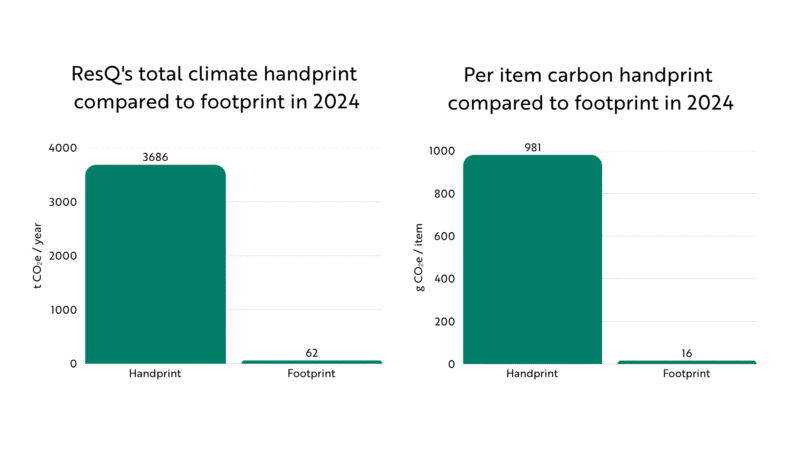
In 2024, ResQ Club’s total carbon handprint was 3 686 t CO₂e, while our own operational footprint was just 62 t CO₂e. This means the climate benefits we enable are nearly 60 times larger than the emissions generated by running our service, resulting in a net positive climate impact of 3 625 t CO₂e.
To put the net positive impact into perspective, that’s equivalent to avoiding the emissions from:

5 484 round-trip
flights from Helsinki to Munich
(Source: Atmosfair)

22 275 354 km
driven in an average gasoline car — equivalent to driving the Helsinki–Oulu route 36,697 times
(Source: DEFRA 2025)

65 903 new
iPhone 17 devices produced
(Source: Apple)
The difference between the two scales highlights that ResQ’s largest climate impact doesn’t come from optimizing our own operations (though we do that too)—it comes from enabling people to make better choices. The avoided emissions from rescued meals alone exceed our total operational footprint many times over.
How the Assessment Was Done
We wanted this assessment to be rigorous, transparent, and scientifically sound. Here’s how NGS Finland approached it.
Life Cycle Assessment Scenarios
The handprint was calculated using life cycle assessment (LCA), a standardized method that compares alternative scenarios following VTT Carbon handprint guide V. 2.0 guidelines:
- Baseline scenario: The item goes unsold → becomes waste → no one gets to enjoy it. In some cases, new fresh food must be produced to replace what was wasted.
- ResQ scenario: The item is rescued through our platform → eaten rather than binned → fewer new items need to be produced. (Note: rescued items are sold in takeaway packaging, which is included in our calculations.)
The different scenario types considered are restaurant meals, cafe products, grocery bags, flowers, wholesale products and cosmetics. The assessment only includes what differs between these scenarios. For example, preparing the original meal happens in both cases, so it doesn’t affect the comparison.
System boundaries
The assessment covers all stages from raw material production through food service operations to the point of sale, including storage, manufacturing energy, and takeaway packaging.
Excluded are energy used by customers for storing or heating items, the waste management of the takeaway packaging, and other environmental impacts beyond greenhouse gas emissions. These boundaries ensure direct service impact assessment and scenario comparability.
Calculation methods
The calculations follow established LCA standards and emission calculation practices. Here’s what went into them:
- Waste amounts: Determined from actual item counts and weights
- Transport emissions: Calculated using industry-standard default distances
- Restaurant meal emissions: Based on fresh ingredient purchases, with specific emission factors for different protein categories. For two minor protein categories representing only 1.5% of total sales, we used simplified calculations due to limited data—a minor adjustment that doesn’t affect overall accuracy.
- Energy consumption: Calculated using national grid averages
- Packaging emissions: Based on average items per order and standard emission factors for different materials, including transport to points of sale
Assumptions
Because not every detail can be known, some assumptions were needed in the calculations, drawing on scientific databases, ResQ’s own data, and practical experience. Average item and packaging weights, how packaging is used across different scenarios, typical transport distances, and the need for refrigerated deliveries were all estimated using conservative values. In other words, we have intentionally avoided overstating ResQ’s positive climate impact.
Looking ahead
With this handprint calculation, we can now communicate our impact with greater transparency, confidence, and scientific credibility.
The report’s findings highlight something essential: scaling our service has a far greater climate impact than marginal operational tweaks.
While we remain committed to keeping our footprint low, the true climate lever lies in enabling more people, businesses, and communities to rescue more surplus goods. This is what climate positivity looks like in practice: a small operational footprint paired with a large, measurable benefit for society.
ResQ Club’s community, partners, and team are already part of the solution. This report gives us the data to prove it and the motivation to keep growing our impact.
“The report’s findings highlight something essential: scaling our service has a far greater climate impact than marginal operational tweaks.”
Hungry for more?
If you’d like to dive deeper, the full carbon handprint report is available upon request.
You can explore our carbon footprint assessment in the previous blog post »
And learn more about our collaboration on NGS Finland’s blog »
Contact:
Elsa Ahlfors
Marketing & Sustainability Manager
elsa@resq-club.com
Article written by: Elsa Ahlfors

ResQ Club’s Climate Impact 2024: First Footprint Calculation Is Out
Article in short
• In 2024, ResQ Club’s market-based emissions totaled 61.7 tonnes CO₂e, with no direct emissions (Scope 1).
• Emissions came from Scope 2 (42%) and Scope 3 (58%), primarily from electricity and heating (42%), purchased goods and services (32%), and business travel (12%).
• Total emissions increased by 56% from 2023 due to increased non-renewable electricity use and business travel, particularly for expansion in Germany. Despite the overall increase, emissions per employee decreased, reflecting operational growth and improved reporting.
• ResQ Club plans to calculate its “handprint” to understand the positive impact of reducing food waste and aims to decouple growth from emissions.
At ResQ Club, reducing food waste is at the heart of what we do, but our climate responsibility doesn’t stop there. We’re also committed to taking full accountability for the environmental impact of our own operations. That’s why we’ve calculated our emissions for the first time, in collaboration with climate consultancy NGS Finland Oy.
We’ve measured emissions for both 2023 and 2024 to establish a reliable baseline for future reporting. The assessment covers all of ResQ Club’s operations across our current markets.
Let’s dig into the results.
Our total emissions in 2024
In 2024, ResQ Club’s market-based greenhouse gas emissions amounted to: 61.7 tonnes of CO₂ equivalent (tCO₂eq). The footprint was calculated following the GHG Protocol, the most widely used international standard for emissions accounting, which divides emissions into three scopes, according to whether they are generated directly by a company’s operations or indirectly in the value or supply chain.
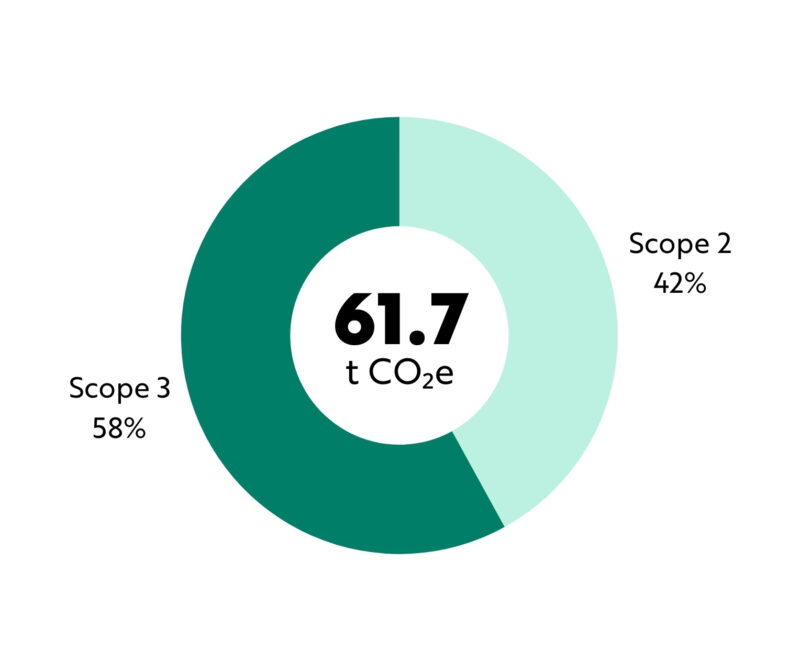
ResQ Club doesn’t generate direct emissions from its own operations (Scope 1). Instead, our entire footprint falls under Scope 2 and Scope 3, which in 2024 were quite evenly split. This is an interesting finding since typically, the vast majority, up to more than 90 % of a company’s total emissions, are scope 3 emissions. Scope 2 made up 42% of our total emissions and covers the indirect emissions from purchased electricity and district heating in our offices in Finland, Estonia, andGermany — with the Finnish office’s use of non-renewable electricity as the main driver. Scope 3 accounted for the remaining 58% and includes all other indirect emissions from across our value chain, such as purchased services, travel, and commuting.
The largest contributors to our footprint were:

Electricity and heating (42%)
ResQ’s purchased energy consists of electricity and district heating used in offices in Finland, Estonia, and Germany. Notably, non-renewable electricity use in Finland is the primary driver of emissions in this category.

Purchased goods and services (32%)
Includes marketing materials, IT services, and food services. IT-related emissions are based on a mix of direct data and spend-based calculations, which may overestimate actual emissions.

Business travel (12%)
As of 2024, we had 34 employees operating in four markets: Finland, Sweden, Estonia, and Germany. Our travel footprint includes flights, hotels, trains, ferries, and buses with international expansion increasing air travel, especially to Germany.
How do the results compare to the previous year?
In 2024, our market-based emissions increased by 56%, from 39.7 to 62.0 tonnes CO₂e, compared to 2023. This was mainly due to a 49% rise in Scope 2 emissions from increased non-renewable electricity use in Finland, and a 61% rise in Scope 3 emissions, driven by higher business travel (especially air travel for expansion in Germany), increased commuting, and IT service emissions.
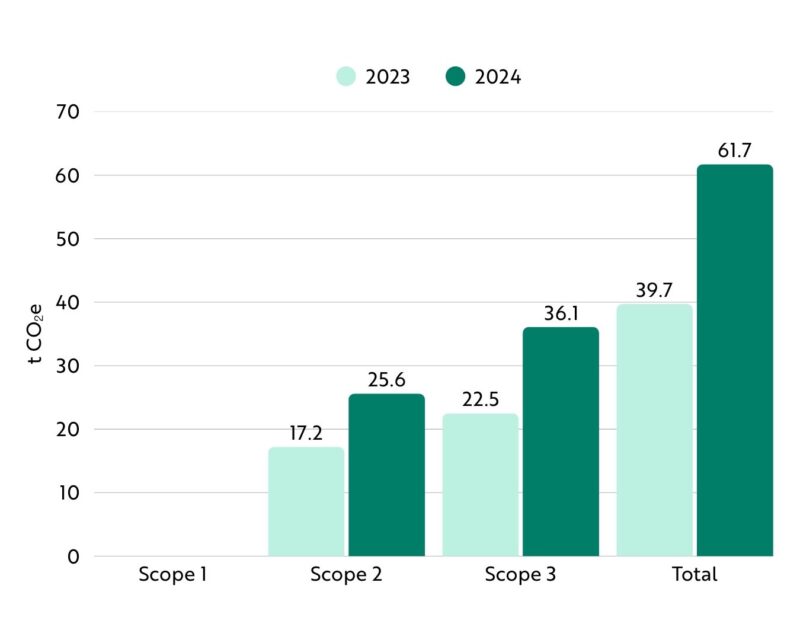
While the overall increase may seem significant, it reflects both operational growth and improved reporting accuracy, helping us build a more reliable baseline for future reduction efforts.
Growing without increasing our emissions
Well, how do ResQ’s emissions stack up against similar companies? This is probably the most asked question.
To put it short, our emissions are relatively small. But we’re not complacent — as a growing company, we recognize that scaling responsibly means working to decouple our growth from emissions.
To track this, we’ve begun monitoring carbon intensity, or emissions relative to turnover, number of employees, and rescued food portions.
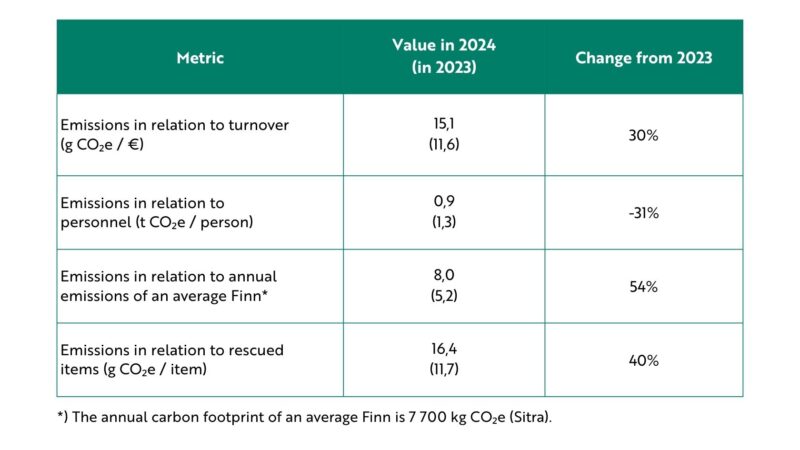
ResQ’s emissions have increased compared to revenue and rescued items but decreased compared to the number of personnel. As the company is still growing, it’s natural for its emissions to grow as well. This is reflected in the emissions per employee decreasing, as the number of personnel has grown faster than the company’s emissions. Normally turnover doesn’t change as quickly as personnel. ResQ is continuing to expand operations into new markets.
You can’t improve what you don’t measure
Measuring emissions is the first step toward real climate action. It helps us make smarter decisions, meet future regulatory requirements, and most importantly – stay true to our mission: reducing environmental impact in all aspects of our operations.
We believe transparency is key to building trust and progress in climate work — and we’re committed to sharing this journey with our community.
That being said, this is the first time we’ve published our emissions. While it’s a good start, we know we are not perfect. We’re committed to improving both our internal operations and the accuracy of our climate reporting.
Based on the results, we’ve identified opportunities to reduce emissions, particularly in energy use and travel, and are exploring ways to address them.
“Only by understanding both our emissions and our avoided impacts can we begin to see the full net effect of our operations on the planet.”
Next step: understanding the net impact of our operations
Measuring emissions shows us the negative side of our footprint but that’s only half the story.
As an impact-driven company giving surplus items a second chance, we’re not just reducing harm but we’re actively creating positive change. That’s why we’re now working to quantify our handprint — the beneficial impact we generate by preventing waste.
Only by understanding both our emissions and our avoided impacts can we begin to see the full net effect of our operations on the planet.
Want to hear more? Let’s chat!
Let us know if you’d like to hear more of the climate report or have questions about our methodology.
You can also read more about our collaboration on NGS Finland’s blog »
Contact:
Elsa Ahlfors
Marketing & Sustainability Manager
elsa@resq-club.com


ResQ Club Expands into Garden Retail with Blomsterlandet Collaboration in Sweden
Can a Food Rescue App Help Save Unsold Plants? ResQ Club and Blomsterlandet join forces to give surplus flowers, plants, and garden goods a second life.
ResQ Club is expanding into a brand-new industry: unsold gardening products. In a unique collaboration, Blomsterlandet becomes the first company in Sweden to offer customers the opportunity to rescue flowers, plants and gardening products that would otherwise go to waste – directly through the ResQ Club app.
Blomsterlandet has long been committed to reducing waste in its stores, including plants and other retail products. Now, the chain is taking the next step by partnering with ResQ Club – a platform that fights unnecessary waste by connecting sustainability-focused businesses with consumers seeking good deals. Through the partnership, individuals can buy unsold yet perfectly viable plants and gardening products at a reduced price, while also contributing to lower levels of store waste.
From a Successful Pilot to Nationwide Launch
The collaboration began as a pilot project in spring 2024 and has since gradually expanded across several Swedish cities. In the pilot phase, nearly 700 customers helped to save over 4,500 items from going to waste. With such positive results, Blomsterlandet and ResQ Club are now taking the next step: launching the initiative in all Blomsterlandet stores across Sweden by the end of April 2025. This makes Blomsterlandet the first retail chain in the garden and plant segment to offer customers the chance to rescue unsold products on a national scale.
“We’re happy that Blomsterlandet was the first to test the sale of unsold flowers, plants, and other products with us on the Swedish market. The collaboration has been incredibly insightful, and together we’ve proven there is strong demand for this kind of service. Sustainable development requires cross-industry cooperation, and this partnership is a great example of how businesses can work together to create meaningful impact,” says Anna-Lotta Svensson, Head of Sales at ResQ Club.
A True Win-Win – Working Together for a More Sustainable Future
Blomsterlandet sees this initiative as a key part of its broader sustainability efforts. Growing, transporting, and then having to dispose of plants creates both environmental and economic strain. By offering unsold but still thriving products through ResQ Club, the company reduces waste while giving customers a more sustainable and affordable option.
“We’re proud to be the first flower and garden retail chain in Sweden to use the ResQ Club app to reduce waste in our segment. This initiative is a part of our sustainability work and helps us take greater responsibility for resources and reduce our climate footprint,” says Andreas Karlsson, Head of Purchasing at Blomsterlandet.
For customers, the collaboration is a chance to shop responsibly and support a more sustainable retail sector. It also shows that sustainability and profitability can go hand in hand, notes Anna-Lotta Svensson.
“Collaborating with a company that shares our sustainability values has truly been a perfect match. Blomsterlandet is committed to reducing its environmental impact through innovative and responsible practices, while ResQ Club continuously looks for new ways to maximise positive impact by rescuing surplus products,” she concludes.

ResQ Club Expands into Garden Retail with Blomsterlandet Collaboration
Can a Food Rescue App Help Save Unsold Plants? ResQ Club and Blomsterlandet join forces to give surplus flowers, plants, and garden goods a second life.
ResQ Club is expanding into a brand-new industry: unsold garden products. In a unique collaboration, Blomsterlandet becomes the first company in Sweden to offer customers the opportunity to rescue flowers, plants and gardening products that would otherwise go to waste – directly through the ResQ Club app.
Blomsterlandet has long been committed to reducing waste in its stores, including plants and other retail products. Now, the chain is taking the next step by partnering with ResQ Club – a platform that fights unnecessary waste by connecting sustainability-focused businesses with consumers seeking good deals. Through the partnership, individuals can buy unsold yet perfectly viable plants and gardening products at a reduced price, while also contributing to lower levels of store waste.
From a Successful Pilot to Nationwide Launch
The collaboration began as a pilot project in spring 2024 and has since gradually expanded across several Swedish cities. In the pilot phase, nearly 700 customers helped to save over 4,500 items from going to waste. With such positive results, Blomsterlandet and ResQ Club are now taking the next step: launching the initiative in all Blomsterlandet stores across Sweden by the end of April 2025. This makes Blomsterlandet the first retail chain in the garden and plant segment to offer customers the chance to rescue unsold products on a national scale.
“We’re happy that Blomsterlandet was the first to test the sale of unsold flowers, plants, and other products with us on the Swedish market. The collaboration has been incredibly insightful, and together we’ve proven there is strong demand for this kind of service. Sustainable development requires cross-industry cooperation, and this partnership is a great example of how businesses can work together to create meaningful impact,” says Anna-Lotta Svensson, Head of Sales at ResQ Club.
A True Win-Win – Working Together for a More Sustainable Future
Blomsterlandet sees this initiative as a key part of its broader sustainability efforts. Growing, transporting, and then having to dispose of plants creates both environmental and economic strain. By offering unsold but still thriving products through ResQ Club, the company reduces waste while giving customers a more sustainable and affordable option.
“We’re proud to be the first flower and garden retail chain in Sweden to use the ResQ Club app to reduce waste in our segment. This initiative is a part of our sustainability work and helps us take greater responsibility for resources and reduce our climate footprint,” says Andreas Karlsson, Head of Purchasing at Blomsterlandet.
For customers, the collaboration is a chance to shop responsibly and support a more sustainable retail sector. It also shows that sustainability and profitability can go hand in hand, notes Anna-Lotta Svensson.
“Collaborating with a company that shares our sustainability values has truly been a perfect match. Blomsterlandet is committed to reducing its environmental impact through innovative and responsible practices, while ResQ Club continuously looks for new ways to maximise positive impact by rescuing surplus products,” she concludes.

